
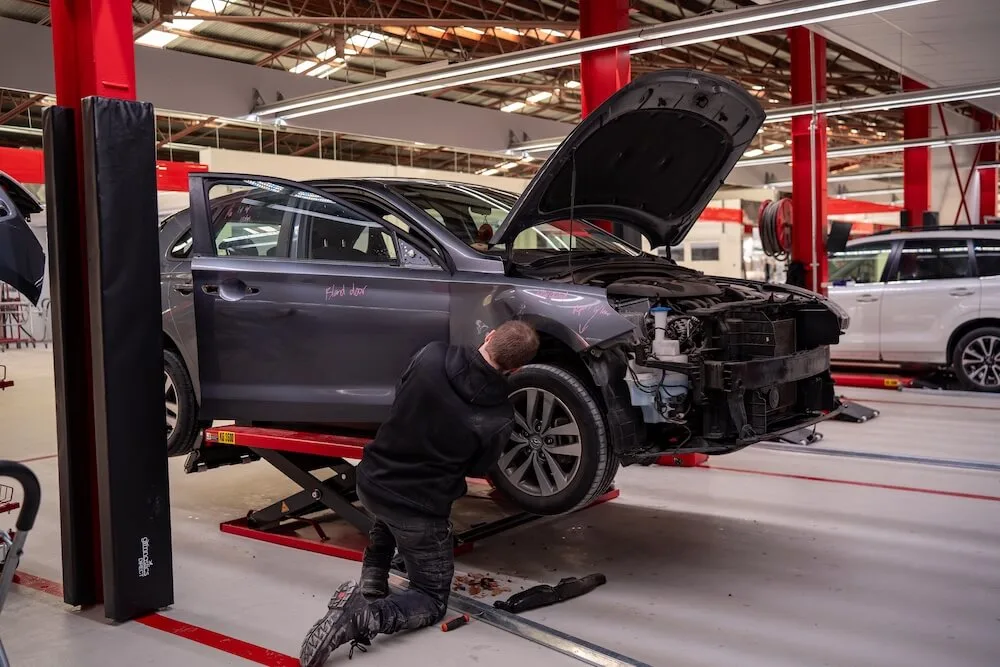
The dust has finally settled, everyone is safe, and you are staring at your bumper trying to gauge the severity of the impact. While a few scratches might seem manageable, industry experience within professional accident repair networks suggests that what you see on the surface is rarely the full story. Many modern vehicles are designed to hide their battle scars incredibly well, meaning a car that looks perfectly drivable could actually be harbouring critical safety failures that compromise its ability to protect you down the road. Understanding the various types of car damage is essential for any driver. Think of your vehicle’s frame as a human skeleton and the exterior panels merely as the skin. Just as a minor bruise can hide a fracture beneath, pristine paint often conceals a bent chassis or crushed crumple zones. This distinction between cosmetic flaws and structural integrity is vital because knowing how to identify hidden car accident damage determines more than just repair costs—it confirms whether the vehicle is truly safe to operate. Moving beyond the obvious dents reveals operational issues you can feel while driving and the deeper structural concerns that require an OEM-aligned repair facility to diagnose.
Paint Scratches vs. Deep Gouges: Why Your Car’s ‘Skin’ Matters
Seeing a massive streak of foreign colour across your bumper is heart-stopping, but it might not be actual damage. Often, what looks like a deep gash is simply paint transfer—pigment from the other vehicle or a painted barrier that rubbed onto your car’s surface. If a little rubbing compound wipes the mark away, you have likely dodged a costly repair bill. However, when the impact goes deeper than a surface smudge, knowing how to read the different types of car damage to your paintwork is crucial. Modern cars rely on clear-coat integrity—a transparent protective shell—to shield the colour layers from fading and chipping. To determine if a mark is a superficial scuff or a deeper scratch, use this simple diagnostic method:
- Clean the area to ensure dirt isn’t mimicking a scratch.
- Run your fingernail perpendicular across the line.
- Feel the catch: If your nail glides over it, only the clear coat is damaged. If your nail clicks or gets stuck, you have penetrated the base paint layer.
Time is the enemy once that protective layer is breached. When a gouge exposes bare metal, oxidation can begin rapidly, eventually turning a minor cosmetic touch-up into a major rust repair. Exploring car scratch repair options is important, but professional panel technicians utilise advanced colour-matching technology to ensure a flawless finish. Yet, while rust eats away at the surface, impact energy may have distorted the structure beneath. Just as bruised skin can hide a broken bone, a hastily corrected paint job by an uncertified operator might mask a compromised chassis. This is why trusting a specialised collision repair network is always the smartest move for long-term vehicle safety.
The Skeleton Under the Skin: Signs of Structural Damage
Beneath the glossy paint and plastic bumpers lies your vehicle’s true safety cage. While older vehicles relied on heavy steel rails, most modern sedans and SUVs utilise monocoque construction, meaning the frame and the body are a single, fused shell. Think of this design like an eggshell rather than a wire cage; the strength comes from the specific shape of the high-strength steel. When an impact distorts that shape, the car loses more than just its cosmetic appeal—it loses its ability to protect you. Manufacturers engineer specific areas, known as crumple zones, to fold like an accordion during a collision, sacrificing the metal to save the passengers. However, this is a one-time transaction. If a frame is bent or weakened, those vehicle crumple zone effectiveness ratings, as tested by safety authorities like ANCAP Safety, no longer apply. In a subsequent accident, a compromised monocoque may fold too easily, transferring dangerous force directly to the cabin instead of dissipating it away from you. You typically don’t need a laser measuring system to detect these initial structural issues; your eyes are often sufficient tools for a preliminary check. Walk around the vehicle and look for symmetry. If the gap between the quarter panel and the bonnet is wide on the left but pinch-tight on the right, the underlying structure has likely shifted. Watch for these common signs of structural types of car damage:
- Uneven Panel Gaps: Spaces between doors or the boot lid that taper, vary in width, or overlap.
- Resistance: Doors, boots, or bonnets that suddenly catch, stick, or require extra force to latch.
- Creases: Visible wrinkles in the pillars (the posts holding up the roof) or under the boot carpet.
Correcting these issues requires highly specialised structural and internal repairs. Advanced facilities utilise computerised measuring systems to pull metal back into precise factory alignment. Without OEM-aligned standards and proper digital workflows, structural integrity cannot be guaranteed, underscoring the necessity of choosing a highly capable repair network over a local independent shop.
Why Your Car Pulls to the Left: Identifying Hidden Alignment Issues
Even if the body panels look perfect, the precise geometry keeping your tyres flat on the road might be shattered. You typically detect front-end alignment issues after a collision through your hands rather than your eyes. If you are driving on a straight, flat road but must hold the steering wheel turned off-centre to keep the car moving forward, your internal steering components have likely shifted. This sensation confirms that the impact force travelled through the wheels and bent the track rods or struts. Wheels are engineered to roll forward, making them surprisingly fragile when hit from the side. Signs of suspension damage from a side impact are often severe because the control arms buckle easily under lateral pressure. A slide into a kerb or a side-impact crash can bend the wheel hub or snap these links, creating a dangerous instability at highway speeds. Rear axle damage often manifests as dog-tracking, a condition where the back of the vehicle fails to follow the front in a straight line. This crabbing motion requires constant steering correction to maintain a straight path and rapidly destroys tyres, making the vehicle unpredictable on wet tarmac. If you suspect any of these issues, it is crucial to know how to tell if your car is drivable after a minor accident. Fixing these mechanical issues requires replacing bent metal and resetting angles with laser precision. Modern suspension systems are deeply integrated with safety computers, meaning collision repair specialists must also address the invisible network of sensors that may have been disrupted.
The Invisible Brain: How Minor Bumper Damage Disables Safety Sensors
A cracked bumper cover often looks like a cheap, cosmetic fix, but on modern vehicles, this plastic shell protects a sophisticated network of eyes and ears. Behind that flexible skin sits the actual steel impact bar and a suite of delicate Advanced Driver Assistance Systems (ADAS) that manage your car’s situational awareness. When drivers ask if a car is safe to drive with bumper damage, the answer depends heavily on whether these hidden systems were jolted out of position. If a sensor is angled even one degree downward, your automatic emergency braking system might ignore a car ahead or panic-brake for a shadow on the road. Even a low-speed tap in a car park can send a shockwave through the mounting brackets that hold this technology in place. If a bracket bends by just a fraction of a millimetre, the vehicle’s computer receives distorted data. Common technologies concealed within front and rear fascias include:
- Ultrasonic Parking Sensors: Small circles that detect proximity to obstacles.
- Radar Units: Often hidden behind the brand emblem or lower grille, controlling adaptive cruise control.
- Blind-Spot Monitors: Radar plates mounted inside the rear corners of the bumper to watch adjacent lanes.
Restoring these features involves more than just swapping out broken parts; it requires a process called recalibration to digitally teach the car where to look again. According to automotive training authorities, precise ADAS recalibration is non-negotiable for post-repair safety. This specialised capability is a defining feature of a modern, digitally enabled collision repair network, ensuring that all types of car damage—both visible and invisible—are expertly resolved.
Is It a ‘Total Loss’? How Insurers Weigh Damage Against Value
Many drivers assume a car is only written off if it resembles a mangled wreck, but the reality is strictly a mathematical equation. Insurance assessors use specific formulas to determine if the cost of addressing all types of car damage exceeds the vehicle’s market value. When evaluating insurance repairs, the assessor compares the estimate against what the car is worth; if fixing a vehicle costs significantly more than its pre-accident value, it will likely be declared a total loss. Seemingly minor accidents can quickly hit this financial limit due to hidden technological and structural failures that require expert intervention. For fleet managers, these calculations also factor into operational downtime. Utilising dedicated fleet accident repair solutions ensures that repair costs and timelines are managed efficiently, getting vehicles back on the road safely and swiftly. To understand the financial disparity between cosmetic versus structural car damage costs, consider how the complexity scales:
- Cosmetic Fixes: Replacing bumper covers or touching up paint usually falls within standard network repair capabilities.
- Structural Repairs: Straightening a bent monocoque frame involves specialised equipment and extensive labour.
- Safety Systems: Replacing multiple deployed airbags and recalibrating sensors adds significant complexity.
Even if your vehicle is successfully repaired, ensuring it meets strict OEM-aligned standards is vital for retaining its safety and operational integrity. This highlights the importance of partnering with a network that prioritises transparency, consistent communication, and top-tier quality control.
Your Post-Accident Safety Plan: Steps to Ensure Your Vehicle is Road-Ready
Seeing your vehicle after a crash is stressful, but you now possess the insight to look beyond the surface. Instead of just seeing dents, you can distinguish between simple cosmetic flaws and serious structural or technological concerns. This knowledge is your best defence against driving an unsafe vehicle and helps you make informed decisions when scheduling private repairs. Before driving away from an incident, run through this initial post-accident vehicle safety inspection checklist:
- Scan the ground for leaking hidden fluids like green coolant.
- Open and close all doors to ensure the frame hasn’t shifted and latches still align.
- Inspect the glass for stress cracks near the frame edges.
- Check tyres for sidewall gouges or a tilted stance indicating suspension damage.
- Verify that no dashboard warning lights persist after the engine restarts.
While these steps offer immediate clarity, modern vehicle complexity means that advanced safety systems and structural integrity must be validated by professionals. Use your observations to confidently discuss the repair process with a dedicated accident repair network, ensuring that your car is returned to you not just looking pristine, but comprehensively safe, fully calibrated, and completely road-ready.