
If your car has been scraped in a car park, kerbed a bumper, or come out of a minor accident, the first question most people ask is straightforward: how long will it take to get it looking right again? The honest answer on how long to repaint a car in Australia is that it depends on how much of the car needs paint, how much damage sits underneath, and how the booth and curing process is set up. A single panel can be back in your hands the next day. A full-body respray can stretch to two weeks or more.
This guide walks through realistic timelines for each type of paint job, what affects how long the work takes, and what the process actually looks like from drop-off to pick-up. If you are trying to plan around work, school runs, or a rental car, you will finish reading with a clear sense of what to expect.
The Short Answer: Typical Repaint Timelines
Paint jobs are not one-size-fits-all. A small scuff on a bumper is a completely different job to a full-body respray, and the timelines reflect that. Here is what you can generally expect from an Australian collision repair centre for each type of paint work:
- Touch-up or spot repair: A few hours to one day
- Single panel repaint (door, bumper, guard): 1 to 3 days
- Multi-panel repaint (two to four panels): 3 to 7 days
- Partial respray (half the vehicle, for example all doors or one full side): 5 to 10 days
- Full-body respray (the entire exterior, same colour): 1 to 2 weeks
- Full colour change (including door jambs, engine bay, boot): 2 to 4 weeks
These ranges assume a professional workshop using modern waterborne basecoats and infrared or booth-baked clear coats. DIY and budget operators can take much longer, and the quality gap is usually obvious within 12 months.
What Affects How Long a Car Repaint Takes?
Two cars with what looks like the same damage can have very different repair times. The main factors that move the timeline up or down are damage extent, panel prep work, paint system, colour, and workshop workflow.
Extent of the Damage
Paint is the finishing layer. If the panel underneath is dented, creased, or has broken trim clips, all of that needs to be repaired before any colour goes on. A straight panel with a light scratch might only need a few hours of prep. A panel with a fist-sized dent needs panel beating, filler, block sanding, and priming before it is ready for paint. That alone can add a day or two to the job.
Paint Prep and Masking
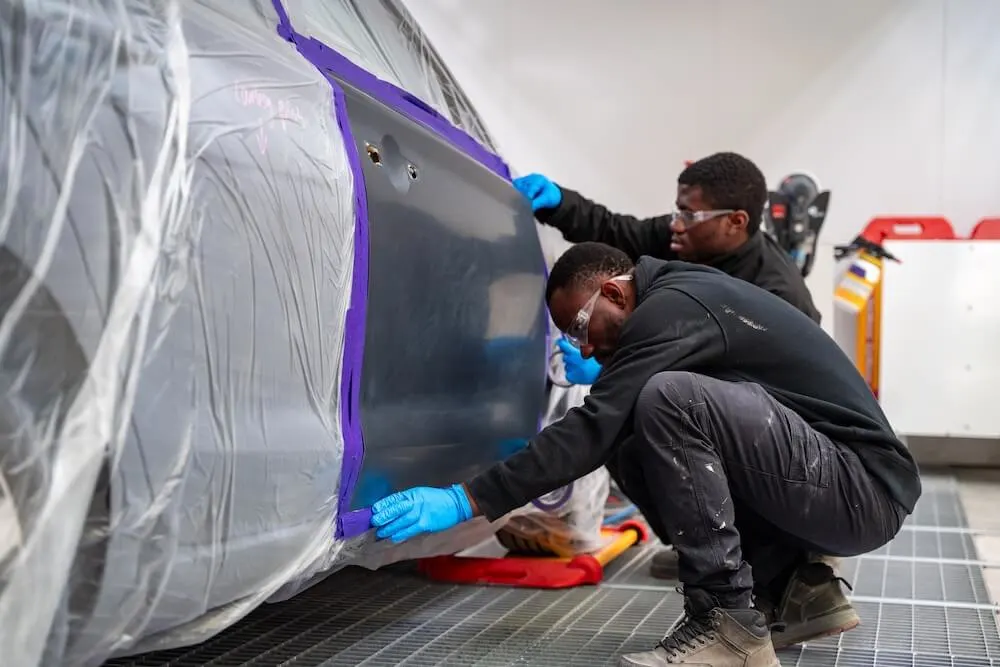
Most of a professional repaint is actually prep, not painting. Strip-down, sanding, masking off glass and trims, and cleaning the panel typically accounts for 60 to 70 percent of the total labour. Skipping this step is how you end up with overspray on rubber seals, fisheyes in the clear coat, or paint lifting within a year.
Paint Type and Curing Time
Modern automotive refinishing in Australia almost always uses waterborne basecoats combined with two-pack (2K) clear coats, which is the standard promoted by major paint manufacturers like PPG Refinish ANZ and Axalta Australia. These paints need to flash off between coats and then cure under controlled heat. A typical booth bake runs around 30 to 60 minutes at 60°C, and the panel will keep hardening over the next 24 to 72 hours before it is safe to polish, reassemble, and hand back to the owner.
Colour and Finish
Solid colours like plain white or black are the quickest to match and apply. Metallic, pearl, and tri-coat finishes need extra layers and more careful blending into adjacent panels so the colour looks uniform in every light. A tri-coat pearl on a single panel can add half a day on its own.
Workshop Workflow and Insurer Process
How the workshop is set up matters almost as much as the damage itself. Traditional repair shops often sequence jobs one at a time, which means your car can sit and wait while another vehicle is in the booth. High-volume rapid-repair centres use parallel workflows and dedicated booths for smaller jobs, which is why insurer-integrated networks can turn drivable vehicles around far faster than an average independent.
The Car Repaint Process, Step by Step
Understanding the stages helps explain where the time actually goes. A professional repaint generally follows this sequence:
- Assessment and quote: The damage is inspected, photographed, and costed. For insurance jobs, this usually happens digitally before you even drop the car off.
- Strip-down: Trims, badges, handles, and sometimes bumpers are removed so paint can be applied cleanly to the full panel, not sprayed around obstacles.
- Panel repair: Any dents are pushed out, welded, or filled. The panel is block-sanded until it is straight.
- Priming: A primer-surfacer is applied, sanded smooth, and sealed. This is the foundation every coat above sits on.
- Masking: Glass, trim, wheels, and adjacent panels are carefully masked. On a blend repair, the masking strategy determines whether the colour match will be invisible.
- Base coat: Two to three coats of colour go on, flashing off between each.
- Clear coat: Two coats of 2K clear are applied for gloss and UV protection.
- Baking and curing: The panel is baked in a spray booth and then left to cure before any polishing.
- Polishing and reassembly: Minor dust nibs are polished out, trims and badges go back on, and the vehicle is detailed.
- Quality check and handover: A final inspection under good light before you get the keys back.
Industry-trained technicians, including those accredited through I-CAR Australia, follow these steps for every job, whether it takes one day or three weeks.
Why Some Repair Centres Are Faster Than Others
If you have ever had two quotes for the same job and been told one workshop needs 10 days and another needs 3, you are not imagining it. The difference usually comes down to process design, not corners being cut. Purpose-built rapid-repair centres focus on drivable vehicles with small to medium damage, which lets them run assembly-line style workflows, dedicated booths, and pre-ordered parts.
At Capital SMART, for example, the Key2Key™ tracking system and insurer integration mean most paint and refinishing jobs on drivable vehicles are completed in 1 to 3 days rather than the industry average of 5 to 7. That is possible because digital bookings, parts, and booth time are all sequenced before the car arrives. For bigger structural jobs that need more time, the same transparency applies: you know each stage of the repair in real time instead of chasing updates by phone.
Repaint Timelines by Situation
After a Minor Accident or Scrape
Most post-accident paint work falls into the single or multi-panel category. If your vehicle is still drivable and the damage is cosmetic or lightly structural, you are typically looking at 1 to 3 business days in a rapid-repair facility and 5 to 10 days in a traditional smash repairer. Insurance-integrated workshops are usually the fastest because approvals, parts, and booking windows are handled in the background.
Repainting for Resale or Restoration
Full resprays for presentation, not accident damage, take longer because there is less pressure to return the vehicle and more focus on flawless finish. Expect 2 to 4 weeks for a same-colour respray and up to 6 weeks for a full colour change where door jambs, the engine bay, and boot cavity all need matching.
Fleet and Commercial Vehicles
For fleet operators, downtime is cost. Dedicated fleet repair services prioritise scheduling and next-day completion for drivable vehicles so your operations keep running. Larger panel swaps on vans and utes typically finish within 3 to 5 days.
How to Keep Your Repaint Timeline as Short as Possible
A few simple habits make a real difference to how quickly you get your car back:
- Provide clear damage photos upfront. Digital quoting can shave 1 to 2 days off the front end.
- Use your insurer’s preferred network. Approvals and parts ordering happen in parallel rather than sequentially.
- Drop off early in the week. A Monday drop-off gives the workshop a full cure window before the weekend.
- Confirm parts availability before booking in. A backordered bumper cover can hold a job for a week.
- Ask about drivable repair pathways. If your car is safe to drive, it usually qualifies for the fastest track.
Frequently Asked Questions
How long does it take to repaint one panel on a car?
A single panel repaint typically takes 1 to 3 business days at a professional workshop. That covers prep, priming, colour, clear coat, baking, curing, and reassembly. A rapid-repair centre handling a drivable vehicle can often return it the next day if the damage is purely cosmetic and parts are on hand.
How long does a full car respray take in Australia?
A full same-colour respray usually takes 1 to 2 weeks. A complete colour change, where door jambs, engine bay, and boot are also painted, is closer to 2 to 4 weeks. Restoration-grade work with bare-metal stripping can run longer again.
Can I drive my car straight after it has been repainted?
Yes, once the workshop hands it back. The booth-baked clear coat is touch-dry within a couple of hours and hard enough to drive within 24 hours. Full chemical cure takes around 30 days, which is why most repairers recommend avoiding automatic car washes, polish, and waxing during the first month.
Why does my insurance repair take longer than the workshop quoted?
Most delays happen outside the painting itself. Parts ordering, supplementary damage found during strip-down, and approval turnaround between the insurer and repairer all add time. Insurer-integrated networks reduce this by handling approvals digitally in the background, as noted by the Insurance Council of Australia.
Is same-day car painting possible?
For very minor work like small scratches, stone chips, or scuffs on a bumper, yes. A cosmetic spot repair or touch-up can be done in a few hours. Anything involving a full panel, blending, or clear coat across multiple surfaces needs at least one overnight cure.
Final Thoughts
The timeline for repainting a car comes down to three things: how much of the vehicle needs paint, how much underlying repair sits beneath it, and how the workshop is structured. A modern, insurer-integrated rapid-repair centre can return a drivable vehicle with cosmetic damage in 1 to 3 days. A traditional smash repairer on the same job might take 5 to 10 days. A full-body colour change will always need two to four weeks, regardless of who does it.
If you are weighing up your options after an accident or scrape, the fastest path is usually a repairer set up specifically for drivable vehicles and integrated with your insurer. To see what that looks like for your situation, find your nearest Capital SMART centre or request a private quote with a few photos of the damage.