
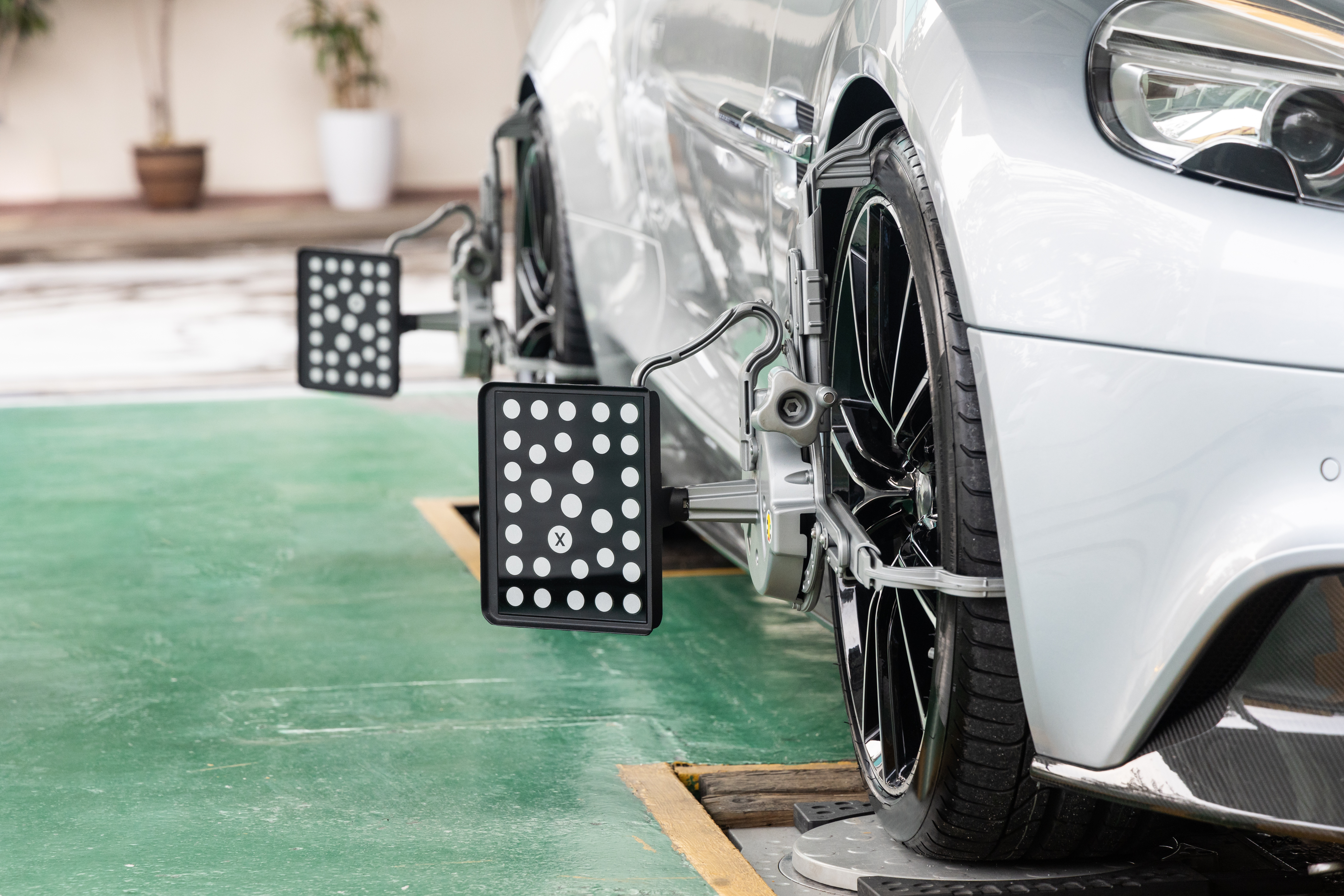
If you’ve had an accident, the repair you’re picturing is probably the visible part. The dent smoothed out, the bumper straightened, the paint matched so closely you can’t tell anything happened. But on most cars built in the last few years, there is a second repair that has to happen alongside the panel work, and you will never see it. It’s called ADAS calibration, and it’s the process of realigning the cameras, radar and sensors that run your car’s safety features.
Those systems are the reason your car can brake on its own when someone steps off the kerb, warn you when you drift out of your lane, and tell you there’s a vehicle sitting in your blind spot. They only work if the sensors feeding them are aimed exactly where the manufacturer intended. A knock that barely marks the paint can be enough to move them.
Here’s what calibration actually involves, which repairs trigger it, and why a car that drives perfectly well can still have safety systems looking in the wrong place.
What Is ADAS Calibration?
ADAS stands for advanced driver assistance systems. It’s the collective name for the technology that watches the road on your behalf: autonomous emergency braking, lane keep assist, blind spot monitoring, adaptive cruise control, rear cross-traffic alert and parking sensors.
None of it works without sensors, and those sensors are spread around the outside of your car. There’s usually a forward-facing camera mounted behind the windscreen near the rear-view mirror. There’s often radar behind the front bumper or grille. Ultrasonic sensors sit in the bumper skins. On many vehicles there are cameras built into the door mirrors for the surround-view display.
ADAS calibration is the process of confirming that each of those sensors is pointing exactly where the manufacturer specified, and correcting it when it isn’t. It’s angle work, and the tolerances are tight. A sensor knocked out by a single degree has barely moved at the sensor itself, but project that error a hundred metres down the road and it’s out by nearly two metres. That’s the difference between a system reading the car in your lane and one reading the car in the next lane over.
It’s worth clearing up a common assumption: calibration is not a software reset or a button somebody presses. It’s a physical alignment procedure carried out to the manufacturer’s specification, using their targets at their prescribed distances and heights, and then verified before the car goes back to you.
Why Nearly Every New Car in Australia Has ADAS
You might assume this only applies to European luxury cars or the newest electric vehicles. It doesn’t. Australia has mandated this technology.
Australian Design Rule 98/00 requires car-to-car autonomous emergency braking, and ADR 98/01 extends that to pedestrian detection. According to ANCAP, the requirement applied to newly introduced models from March 2023 and to all models on sale in Australia from March 2025, covering passenger cars, off-road passenger cars and light goods vehicles.
The reason is straightforward. ANCAP notes that autonomous emergency braking has been shown to cut police-reported crashes by 55 per cent, rear-end crashes by 40 per cent and occupant trauma by 28 per cent. These are not gimmicks. They are among the most effective safety additions to cars in decades.
The practical upshot is that if you’re driving a recent Corolla, HiLux, i30, CX-5 or Ranger, you almost certainly have ADAS on board, whether or not you think of your car as a technology car. And if it’s been in an accident, those systems are part of the repair conversation.
Which Repairs Trigger ADAS Calibration?
This is where most drivers are caught out. You don’t have to damage a sensor to need calibration. I-CAR Australia, the industry’s technical training body, is explicit on this point: removing a bumper, windscreen or suspension component, and even variation in paint thickness, can affect ADAS components and require recalibration, regardless of whether any ADAS part was being repaired.
Bumper repairs and replacement
Front and rear bumpers are dense with sensors. Radar for adaptive cruise and forward collision warning commonly sits behind the bumper or grille, and ultrasonic parking sensors sit in the bumper skin itself. Repairing that bumper usually means removing it, and refitting it a fraction out of position changes what the radar behind it is looking at. Even bumper damage that looks purely cosmetic can put a calibration on the job sheet.
Windscreen replacement
The forward-facing camera is mounted to the glass. Replace the windscreen and that camera is sitting on a new surface with a slightly different position and angle, even though nobody laid a finger on the camera. This is the single most common calibration trigger in the industry.
Paint and refinishing
This one surprises people. Radar sensors read through the bumper cover in front of them, and the material and thickness of that cover matters. Heavy filler, incorrect repair methods or excessive coating build-up can change how the sensor sees the road. It’s one of the reasons paint and refinishing work needs to be done to specification rather than just to a good-looking finish.
Suspension, ride height and wheel alignment
Sensors are aimed relative to the road surface and the vehicle’s centreline. Anything that changes how the car sits or which way it tracks changes where they point. That includes suspension work, a wheel alignment, or a change in ride height. It also applies to modifications: I-CAR Australia warns that suspension lifts, larger tyres and bullbars can significantly affect ADAS, and that insurers may decline a claim where a modified vehicle was never recalibrated.
Mirrors, doors and body panels
Surround-view camera systems put cameras in door mirrors and sometimes in door panels. Replacing a mirror housing or realigning a door can shift them out of position, and structural and internal repair work can move sensor mounting points that sit behind the visible panels.
Why “It Drives Fine” Is the Wrong Test
Here is the part that makes this genuinely worth understanding. A miscalibrated ADAS system usually doesn’t put a warning light on your dash. It doesn’t fail loudly. It carries on reporting information that is slightly wrong, with complete confidence.
That plays out in two ways, and both are a problem. The system might not intervene when it should, because it’s reading empty road where there’s actually a stopped car. Or it might intervene when it shouldn’t, braking hard for a shadow or an overhead sign because it’s aimed a few degrees too high. Drivers describe the second one as phantom braking, and it’s unnerving in traffic.
The deeper risk is behavioural. You go on driving as though the safety net is there, because nothing has told you otherwise. The systems that were designed to catch your worst moment are the ones you find out about only when you need them.
Static and Dynamic Calibration Explained
There are two methods, and plenty of vehicles need both.
- Static calibration: carried out in the workshop with the vehicle stationary. It requires a level floor, controlled lighting, and manufacturer-specified targets set at exact distances, heights and angles from the vehicle.
- Dynamic calibration: carried out on the road. The vehicle is driven at a specified speed on roads with clear lane markings so the system can relearn and confirm its own reference points.
The sequence matters as much as the method. Some manufacturers require a wheel alignment before calibration, because calibrating to a crooked thrust line just locks in the error. Others specify a particular order when several systems are involved. This is set out in the manufacturer’s repair procedure for that specific vehicle, which is why it isn’t something that can be judged by eye or applied as a one-size process.
ADAS Calibration and Your Insurance Claim
Calibration should not be something you discover afterwards and chase separately. Where the repair triggers it, it belongs in the scope of works from the start, alongside the panel and paint.
Two useful questions to ask your repairer: has ADAS calibration been identified in the scope for my vehicle, and are pre-repair and post-repair diagnostic scans being carried out? A scan before the work starts records what the car’s systems were reporting on arrival, and a scan afterwards confirms the systems are functioning as they should be before you drive away.
Capital SMART works directly with major insurer partners, so where you’re going through a claim, calibration requirements are assessed and coordinated as part of the approved repair rather than left for you to sort out. You can read more about how insurance repairs work, or find the detail of what the process involves on our ADAS calibration page. Most minor repairs are completed within days, though calibration requirements, parts availability and insurer approvals all influence timing on any individual job.
Frequently Asked Questions
Is ADAS calibration necessary?
Where the manufacturer’s repair procedure calls for it, yes. It isn’t an optional upgrade or an upsell. If a repair has moved a sensor, or moved the panel a sensor references, the system needs to be realigned and verified for the safety features to work as designed. Skipping it leaves a car that looks repaired but isn’t fully repaired.
How long does ADAS calibration take?
It depends on the vehicle and how many systems are involved. A single static calibration on a straightforward vehicle can be completed in well under a day. A car needing several systems recalibrated, a wheel alignment beforehand and a road drive to finish will take longer. It’s usually carried out as part of the overall repair rather than as a separate visit.
How much does ADAS calibration cost?
There’s no single figure, because it depends on which systems your vehicle has, how many need attention, and whether static, dynamic or both procedures are specified. When you’re repairing through an insurance claim, calibration is generally assessed and approved as part of the repair rather than billed to you separately. For a private repair, ask for it to be itemised in your quote so you can see exactly what’s included.
Do I need ADAS calibration after a wheel alignment?
Often, yes. Cameras and radar are aimed relative to the direction the vehicle actually travels, so changing the alignment can change where they effectively point. Some manufacturers specifically require calibration after alignment work. If your repair involved suspension, steering or alignment, it’s worth asking directly.
Does insurance cover ADAS calibration?
Where calibration is required to complete the repair properly, it is normally part of the approved repair scope under a claim. Coverage always comes down to your individual policy and insurer, so confirm it with them. The important thing is that a repairer who scopes the job correctly will raise calibration up front rather than treating it as an extra.
Getting Your Car Back to Pre-Accident Condition
A complete repair means the car is as safe as it was before the accident, not just as good-looking. On a modern vehicle, that includes the systems you can’t see.
Capital SMART has completed more than two million repairs across Australia and New Zealand over more than fifteen years, with 60-plus accident repair centres and OEM parts available on request. If your car has been in an accident, find your nearest repair centre or request a private quote and we’ll talk you through what your repair involves.